

HeartLung.AI to Present Eight Abstracts at AHA 2026, Advancing a New Era of Preventive Screening
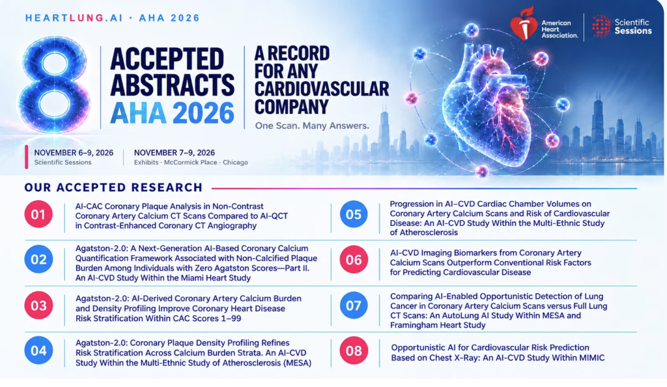
HeartLung's 8 accepted abstracts to be presented at AHA 2026
Research spans coronary plaque, Agatston-2.0, cardiac chambers, lung cancer and chest X-ray AI; visit Booth 641 throughout the Chicago exhibits.
CHICAGO, IL, UNITED STATES, November 2, 2026 /EINPresswire.com/ -- HeartLung Corporation (HeartLung.AI) will present eight accepted scientific abstracts at the American Heart Association (AHA) Scientific Sessions 2026, taking place November 6–9 at McCormick Place in Chicago. The research program brings together emerging advances in coronary plaque assessment, AI-based calcium scoring, cardiac chamber analysis, lung cancer risk assessment and cardiovascular prediction from routine chest X-rays.Together, the studies advance a bold idea for preventive medicine: a scan should be the beginning of a broader understanding of risk, not the end of a single-purpose report. By studying how artificial intelligence can extract additional quantitative information from imaging obtained in everyday clinical care, HeartLung.AI and its academic collaborators aim to make earlier, more personalized prevention possible.
“We believe the future of preventive screening is one scan, many answers. These eight abstracts reflect our ambition to uncover more actionable insights from imaging, identify overlooked risk and help move preventive care earlier in the disease journey.”
— Morteza Naghavi, MD, Founder and President, HeartLung Corporation
EIGHT ACCEPTED ABSTRACTS: RESEARCH WITH REAL-WORLD PREVENTIVE POTENTIAL
01 AI-CAC Coronary Plaque Analysis in Non-Contrast Coronary Artery Calcium CT Scans Compared to AI-QCT in Contrast-Enhanced Coronary CT Angiography
This study compares investigational AI-CAC plaque analysis from non-contrast coronary artery calcium (CAC) scans with AI quantitative coronary CT (AI-QCT) findings from contrast-enhanced coronary CT angiography (CCTA). Why it matters: It explores whether a simpler calcium scan can yield additional plaque information, while defining the limits of what non-contrast imaging can show.
02 Agatston-2.0: A Next-Generation AI-Based Coronary Calcium Quantification Framework Associated with Non-Calcified Plaque Burden Among Individuals with Zero Agatston Scores—Part II. An AI-CVD Study Within the Miami Heart Study
Among people with a conventional CAC score of zero, researchers examine how Agatston-2.0 measurements relate to non-calcified coronary plaque burden in the Miami Heart Study. Why it matters: The work addresses an important gap in the “power of zero”: a reassuring conventional calcium score does not always mean that all coronary plaque is absent.
03 Agatston-2.0: AI-Derived Coronary Artery Calcium Burden and Density Profiling Improve Coronary Heart Disease Risk Stratification Within CAC Scores 1–99
Researchers investigate whether AI-derived calcium burden and plaque density provide a more informative picture of coronary heart disease risk among patients with conventional CAC scores of 1–99. Why it matters: This widely encountered low-score range is heterogeneous; refined quantitative features could help identify patients who may merit different levels of preventive attention.
04 Agatston-2.0: Coronary Plaque Density Profiling Refines Risk Stratification Across Calcium Burden Strata. An AI-CVD Study Within the Multi-Ethnic Study of Atherosclerosis (MESA)
Using the Multi-Ethnic Study of Atherosclerosis (MESA), this research evaluates plaque density characteristics across levels of coronary calcium burden. Why it matters: It tests the premise that the composition and density of calcification may add prognostic information beyond a single total calcium score.
05 Progression in AI-CVD Cardiac Chamber Volumes on Coronary Artery Calcium Scans and Risk of Cardiovascular Disease: An AI-CVD Study Within the Multi-Ethnic Study of Atherosclerosis
This longitudinal MESA investigation examines changes in AI-measured cardiac chamber volumes on CAC scans and their association with subsequent cardiovascular disease. Why it matters: It highlights a potential additional use of routine cardiac CT: monitoring structural cardiac markers that conventional CAC scoring does not report.
06 AI-CVD Imaging Biomarkers from Coronary Artery Calcium Scans Outperform Conventional Risk Factors for Predicting Cardiovascular Disease
The study evaluates AI-derived imaging biomarkers from CAC scans against conventional clinical risk factors for cardiovascular disease prediction. Why it matters: Its importance is the possibility of complementing established risk assessment with objective measures of coronary, cardiac and related anatomy from imaging already obtained.
07 Comparing AI-Enabled Opportunistic Detection of Lung Cancer in Coronary Artery Calcium Scans versus Full Lung CT Scans: An AutoLung AI Study Within MESA and Framingham Heart Study
Investigators compare AI-based lung cancer assessment using cardiac CAC scans with assessment from full-lung CT scans in MESA and the Framingham Heart Study. Why it matters: The comparison helps determine what useful lung cancer information may be available from limited-field cardiac imaging—and where dedicated lung screening remains essential.
08 Opportunistic AI for Cardiovascular Risk Prediction Based on Chest X-Ray: An AI-CVD Study Within MIMIC
Using data from the MIMIC cohort, researchers evaluate AI-based cardiovascular risk signals in routine chest X-rays, including associations with atherosclerotic events, heart failure and atrial fibrillation. Why it matters: If independently validated, this approach could flag patients for formal cardiovascular risk assessment in settings where laboratory data or established risk scores are not readily available.
MEET HEARTLUNG.AI IN CHICAGO — BOOTH 641
HeartLung.AI’s clinical, scientific and leadership teams will be at Booth 641 in the AHA Science & Technology Hall for the entire time the exhibit hall is open, November 7–9. Visitors are invited to discuss the research, explore case-based AI-CVD workflows and connect about clinical validation, collaboration and responsible implementation of opportunistic screening.
AHA 2026 EXHIBIT HOURS | BOOTH 641 | McCORMICK PLACE, CHICAGO
Saturday, November 7: 9:00 a.m.–4:30 p.m. CT
Sunday, November 8: 9:00 a.m.–4:30 p.m. CT
Monday, November 9: 9:00 a.m.–3:00 p.m. CT
To request a one-on-one meeting during the conference, visit www.heartlung.ai/aha-2026 or email contact@heartlung.ai. HeartLung.AI will participate in the full Scientific Sessions meeting November 6–9; the Science & Technology Hall is open November 7–9.
ABOUT HEARTLUNG.AI
HeartLung.AI is building a new front door to preventive medicine, making advanced, evidence-based health assessment more accessible by unlocking the information already captured in coronary calcium scans and routine chest CTs.
Its FDA-cleared AI-CVD® platform transforms coronary calcium scans and routine chest CTs into comprehensive assessments of cardiovascular and cardiometabolic health. From a single scan, AI-CVD quantifies coronary calcium, aortic and valvular calcification, cardiac chamber size, great-vessel dimensions, fat distribution, liver and lung density, bone mineral density, and muscle composition—helping clinicians see more of each patient’s health without ordering another scan or adding specialized hardware.
HeartLung is extending this opportunistic imaging platform toward a broader vision: earlier insight into heart disease, lung cancer, COPD, osteoporosis, fatty liver disease, and other conditions detectable through coronary calcium scans and routine chest CTs. The company’s cloud-based technology connects with existing PACS or accepts direct scan uploads, delivering AI-generated DICOM and PDF reports through familiar clinical workflows.
The imaging infrastructure is already in place. HeartLung.AI is turning it into a scalable platform for earlier detection and prevention, designed to bring advanced health insights within reach of far more people.
Marlon Montes
HeartLung Technologies
+1 310-510-6004
Visit us on social media:
LinkedIn
YouTube
X
Legal Disclaimer:
EIN Presswire provides this news content "as is" without warranty of any kind. We do not accept any responsibility or liability for the accuracy, content, images, videos, licenses, completeness, legality, or reliability of the information contained in this article. If you have any complaints or copyright issues related to this article, kindly contact the author above.
